
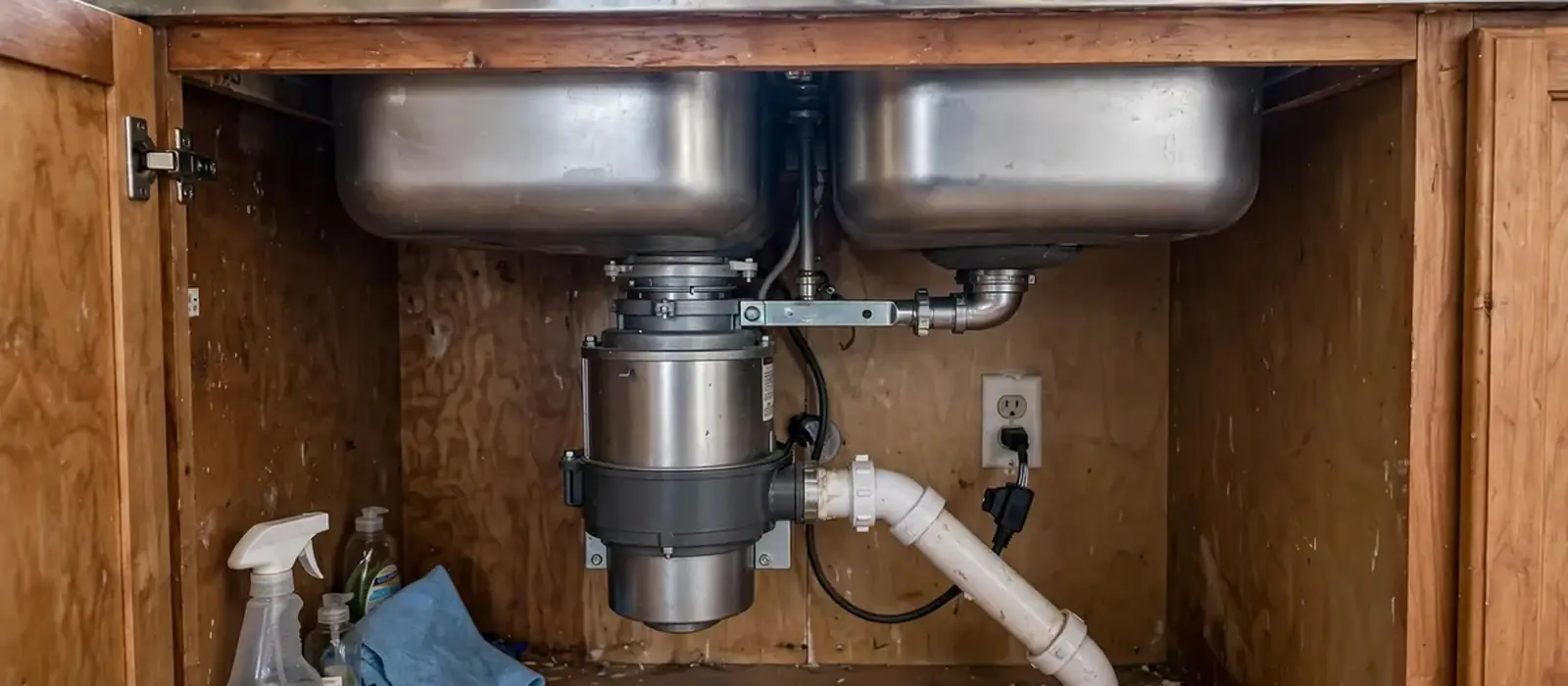
Does your kitchen need a new disposal?
A disposal that hums but does not spin, leaks from the body or tripped its breaker more than once is a candidate for replacement. A jam is often fixable with the hex socket at the bottom of the unit, so try that first. Leaks from the body itself, as opposed to a loose pipe, mean the housing has failed.
If the unit is old and noisy, an upgrade also gets you a quieter motor and better grinding. Our garbage disposal service page covers repair, and this guide focuses on a new install.
SizingChoosing the right disposal
Motor size is the first decision. A small motor handles a household that mostly scrapes plates. A larger motor handles heavier use and tends to run quieter and jam less. Bigger is not always better, because the larger units are taller and heavier, and some sinks have little room beneath them.
Feed type is the second decision. A continuous feed unit runs while you hold a wall switch. A batch feed unit runs only when a stopper lid is in place, which is a safer choice in homes with small children.
| Choice | Fits best when | Trade-off |
|---|---|---|
| Smaller motor | Light use, one or two people | Can jam on fibrous scraps |
| Larger motor | Busy kitchen, family cooking | Heavier, needs more cabinet room |
| Continuous feed | You want quick scraping into the unit | Hand-in-drain risk if switched on by mistake |
| Batch feed | Small children in the home | Needs the lid in place to run |
What an installation involves
Power off
Switch off the circuit at the panel, not only the wall switch, and confirm the power is dead before touching wires.
Remove the old unit
Disconnect the drain pipe and dishwasher hose, then release the mounting ring and lower the unit. Clean the sink opening of old putty.
Mount the new flange
Set the sink flange with fresh plumber's putty or the gasket the maker supplies, then fasten the mounting assembly from below.
Connect and test
Wire the unit, reconnect the drain and dishwasher line and run water to check every joint for leaks.
The sequence is short, but each step has places to go wrong. A flange that is not seated evenly leaks slowly into the cabinet, and a loose wire nut is a hazard.
Dishwasher connection, a step people miss
Many disposals have a small inlet where the dishwasher drain hose connects. New units often have a plug inside that inlet. If a dishwasher is connected, the plug must be knocked out before the hose goes on. If it is left in place, the dishwasher will not drain and dirty water backs up into the dishwasher.
The hose also needs a high loop or an air gap so that drain water cannot flow back into the dishwasher. Ask your plumber to show you how the existing line is routed.
Rather have a plumber handle it?
Call the 24/7 line for disposal installation and an explained price before work starts.
Electrical and drain details that matter
Most disposals plug into an outlet under the sink or are hardwired to a switched circuit. If the old unit was wired a certain way, the new one must be connected the same safe way. If you find damaged wire or no ground, stop and call a licensed pro. Water and electricity share this cabinet.
The drain side matters too. The disposal outlet must sit at the right height to drain into the trap, and a sagging or crooked trap arm will cause slow draining. Fixing that is plumbing work, not just a swap, and it is a common reason a quick DIY becomes a two-hour job.
Common mistakes after an install
- Skipping the dishwasher knockout plug, which stops the dishwasher from draining.
- Over-tightening the mounting ring, which can crack plastic parts.
- Reusing a crumbling rubber gasket or an old drain line.
- Running the unit with no water, which wears out the seals faster.
- Feeding it grease, coffee grounds, pasta, rice, potato peels or fibrous stalks, which clog the drain downstream.
Run a strong stream of cold water while the unit operates, and let it run a short while after the grinding stops so scraps clear the trap and branch line.
Sanger kitchens and disposal habits
Many Sanger homes were built decades ago. The city housing element reports that about 53 percent of homes are more than 30 years old, so drain lines under older kitchens may be narrow, scaled or sagging. A new disposal sends more solid material into those lines, which makes a clean drain even more valuable.
Sanger's water is hard. The city's 2024 report shows an average of 145.5 ppm, and hard water leaves mineral scale inside drains over time. If you add a disposal to an old kitchen, consider having the sink line cleaned. Our drain cleaning team does that, and the same visit can confirm the trap is clean for the new unit.
When to hire a plumber
A straight swap of a same-size unit with good wiring is a reasonable DIY for a handy homeowner. Call a plumber when you are adding a disposal where none existed, when the sink opening is not a standard size, when the drain line needs changes, or when the wiring is not safe.
Homeowners in Reedley and Selma call the same dispatch line for this work. If you are replacing a faucet at the same time, the faucet repair page explains that side of the sink.
FAQInstallation questions
Sometimes, but a disposal adds solids to a septic system and not every system suits one. Ask your septic provider first.
A simple swap often takes a short visit. Added drain or electrical work takes longer, and the plumber tells you before starting.
The flange seal is usually not seated evenly. Loosen, reset the putty or gasket and retighten in small turns.
Same-day appointments are available when schedules allow. Call the line, describe the sink and the dispatcher schedules a plumber.