
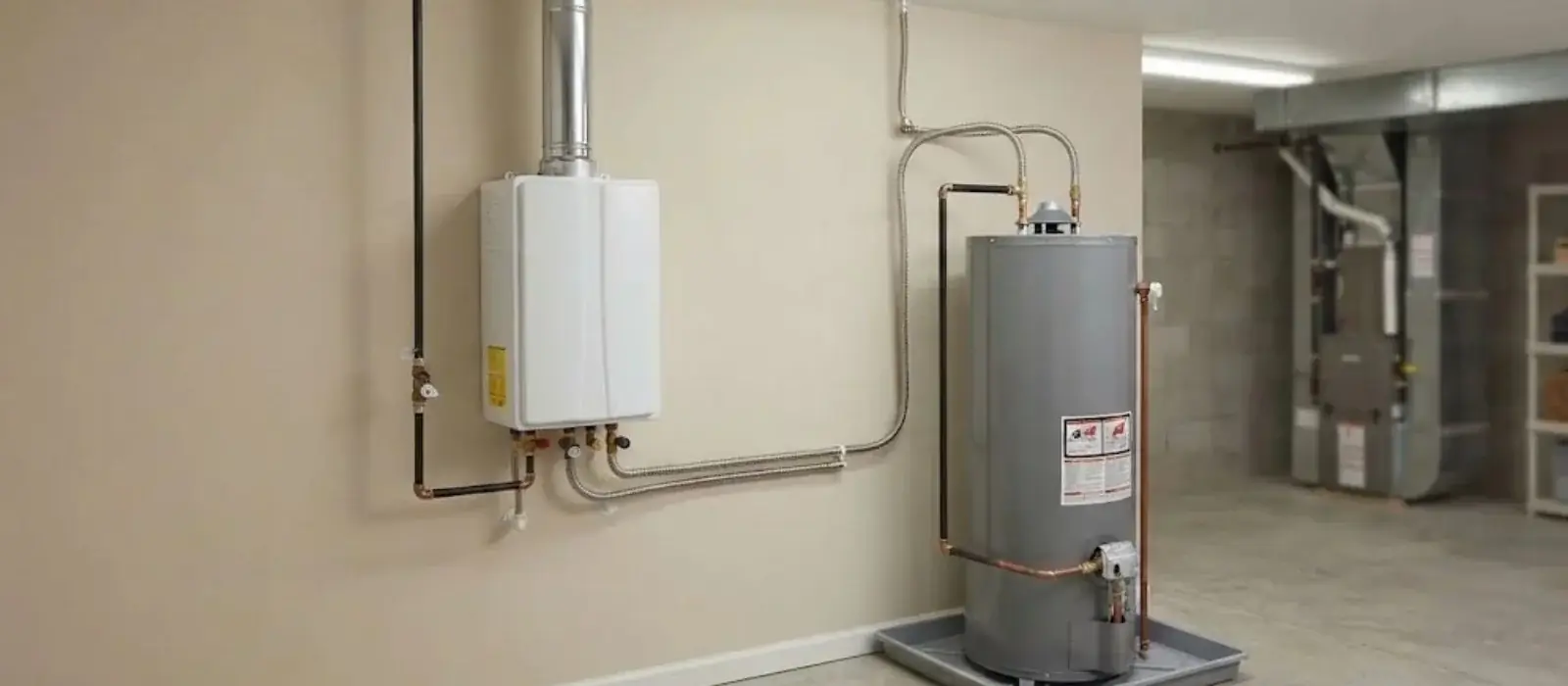
How a tankless water heater works
A tankless unit heats water as it flows. When you open a hot tap, a flow sensor tells the unit to fire a burner on gas models or energize elements on electric models. Water passes through a heat exchanger and leaves hot. When the tap closes, the unit shuts off, so there is no stored tank to keep warm.
The tradeoff is capacity. A unit has a maximum flow rate, and running a shower, a dishwasher and a washer at once can exceed it. Sizing for the home's real demand matters.
MaintenanceFlushing and descaling a tankless heater
The heat exchanger in a tankless unit has narrow passages, so scale hurts it fast. Flushing means circulating a descaling solution, usually white vinegar or a manufacturer-approved product, through the unit with a small pump, then rinsing it. The job takes about an hour.
A scaled exchanger shows up as error codes, lower flow, water that never gets as hot as it did and noise during heating. Many service calls for tankless units are really descaling jobs. Flushing once a year is a common baseline in hard water, and the manufacturer's manual sets the interval.
Local conditionsWhy Sanger water matters
Sanger's city water averaged 145.5 ppm hardness in the 2024 water quality report, and some tests came in as high as 330 ppm. That is moderately hard to very hard water depending on the well. At those levels, scale forms in a tankless heat exchanger much faster than in a tank.
If you own a tankless unit or plan one, ask about a water softener or a scale inhibitor in addition to yearly flushing. Our water softener and filtration page explains the options. Testing the tap is a good first step, since hardness varies by well.
Common tankless problems
Error codes
Many codes point to flow, ignition or scale. A plumber reads the code and tests, then flushes or replaces the part.
Cold water sandwich
Hot water, then a burst of cold, then hot again. It comes from short pauses between uses and unit settings.
Not enough hot water
Demand exceeds the unit's flow. A second unit or a larger model fixes it.
Venting or gas issues
Gas units need correct venting and a gas line sized for the burner. Problems here are a safety matter.
Installing a tankless unit
A tankless install often needs more than a swap. A gas unit may need a larger gas line, new venting through the wall or roof and a condensate drain on a condensing model. An electric unit may need a heavy new circuit. The plumber checks all of this and quotes it before work starts.
Replacing a tank is possible in the same footprint, but the extra work can be larger than expected. If you are comparing, see water heater installation for tank options.
| Question | Tank | Tankless |
|---|---|---|
| Hot water capacity | Limited by tank size | Limited by flow rate |
| Space | Floor space | Wall mounted |
| Maintenance in hard water | Yearly flush, anode rod | Yearly descale |
| Install complexity | Lower | Higher with venting and gas |
Rules and permits
California requires licensed contractors for plumbing and gas work, and the C-36 classification covers water heater installation. Permit rules vary by city, so ask the Sanger Building Division whether your project needs one. Gas work and venting are safety items, so skip DIY.
What affects the price of tankless service
Flushing is a short job and installs are larger. We give a clear price before work starts.
Insurance does not cover maintenance. Check whether a warranty requires documented yearly flushing, because many do. Want your real number? Call (855) 575-2890.
Tankless unit throwing errors?
Call the line. Describe the code and when it started.
What to do before the plumber arrives
- If you smell gas, leave the building and call the gas utility or 911.
- Do not block the vent or the combustion air path.
- Shut off the gas and the water before any work on the unit.
- Do not remove the front cover on a powered unit.
Codes for tankless heaters
Gas tankless units need a vent rated for their exhaust and a gas line sized for their load, according to the UPC-based California Plumbing Code and the manufacturer's installation instructions. Electric units depend on panel capacity and are subject to the National Electrical Code (NEC), so an electrician may be involved.
FAQTankless water heater questions
At least once a year in hard water, and sooner if you see error codes or reduced flow. Follow your manufacturer's manual.
Our dispatch line is open 24/7, and a no-hot-water call is booked same-day when available.
It is not required, but softened water reduces scale. Ask about your water and the unit's warranty.
Pressure or temperature may be too high, or the valve may be worn. A plumber tests and replaces it.