
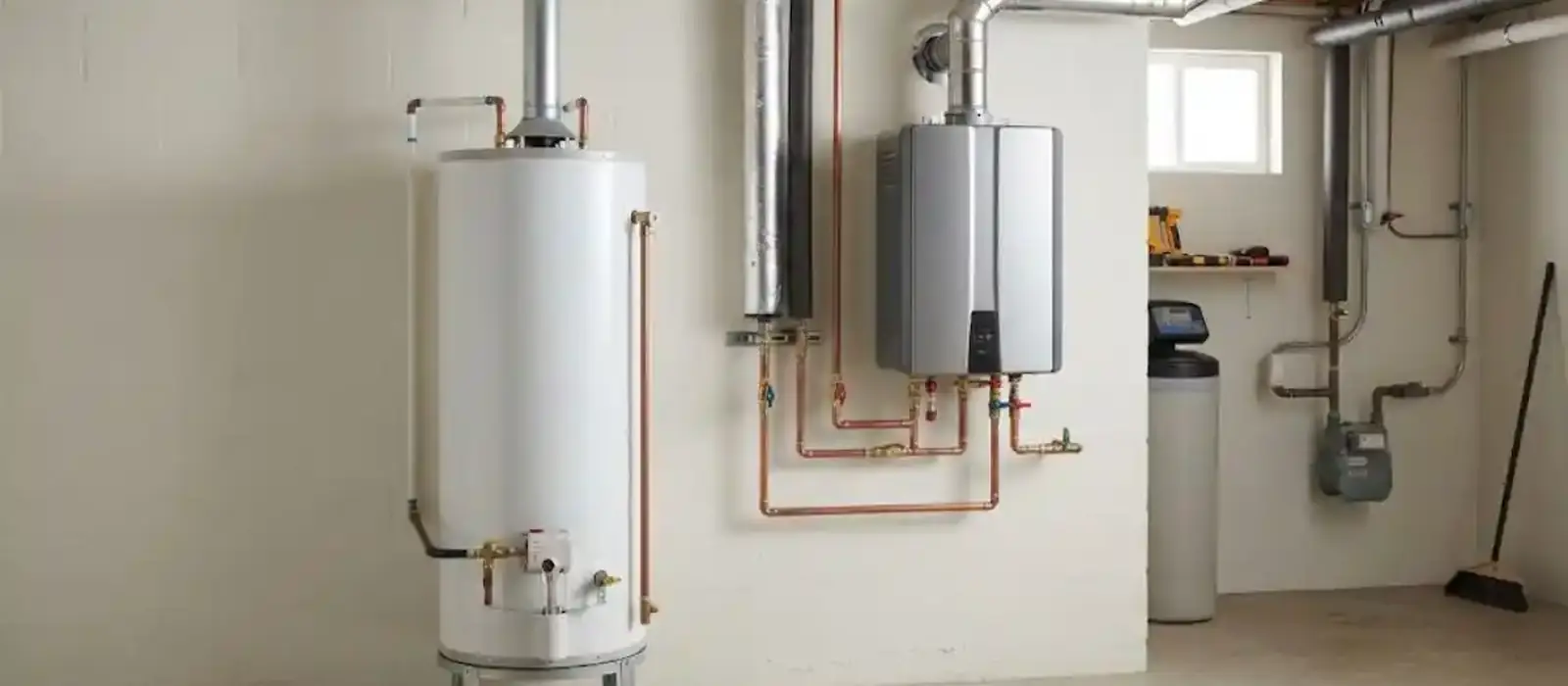
How a tankless heater works
When you open a hot tap, flow sensors tell the unit to fire. A gas burner or an electric element heats water as it passes through a heat exchanger. There is no big tank to keep warm, so the unit uses energy only while hot water is running.
The unit delivers hot water continuously, as long as the demand stays within its flow rating. That rating is the main limit of the system.
The benefits, in order of how much they matter
Hot water that does not run out
A tank can empty after a few showers. A tankless unit keeps heating as long as flow is within its rating.
Less standby heat loss
A tank keeps water hot around the clock. A tankless unit does not, so it avoids that loss.
Smaller footprint
Most units hang on a wall and free up floor space in a closet or garage.
Long service life
Manufacturers rate many tankless units for a longer life than tank models, provided they are maintained.
No tank to burst
A tank can fail and flood a room. A tankless heater holds only a little water, so a leak is smaller.
The drawbacks nobody should hide
A tankless heater costs more to buy and install than a tank of similar capacity. Gas units often need a new vent, a larger gas line, or both. Electric units can need a heavy circuit that a panel may not have room for.
Flow matters too. If several fixtures run at once, a small unit may not keep up, and the water will cool. Sizing the unit to the household is the key decision.
Tank versus tankless at a glance
| Factor | Tank heater | Tankless heater |
|---|---|---|
| Upfront cost | Lower | Higher |
| Hot water supply | Limited by tank size | Continuous within the flow rating |
| Energy use | Includes standby loss | No standby loss |
| Space | Needs floor space | Wall mounted |
| Installation | Often straightforward | May need vent, gas or circuit upgrades |
| Maintenance | Flush and check the anode rod | Descale on a regular schedule |
The water heater installation page covers either type, and a plumber can size a unit to your household.
Want a straight answer on tankless?
Call the 24/7 line. A dispatcher schedules a licensed plumber who compares both options for your home.
Maintenance: the part people skip
Tankless heaters need descaling. Minerals collect inside the heat exchanger and cut flow and efficiency. Most manufacturers call for periodic flushing with a descaling solution. Skipping it can void a warranty and shorten the unit's life.
Many installers add service valves at the time of installation to make the flush easy. Ask for them if they are not in the quote.
Who tends to benefit most
- Households that run out of hot water with a tank.
- Homes that want to free up closet or garage space.
- Owners who plan to stay long enough to recoup a higher upfront cost.
- Properties where a gas line and vent upgrade are practical.
- Households with moderate, predictable hot water demand.
A single resident in a small place may do well with a tank. A large family with back-to-back showers may do better with tankless. Think about your pattern of use, not the average.
Safety and code points
Gas tankless heaters burn fuel and must vent exhaust outdoors. A faulty vent can leak carbon monoxide into a home. If you smell gas, leave the building and call your gas utility or 911 from outside. Install carbon monoxide alarms near sleeping areas whenever you have a gas appliance.
Have a licensed plumber handle gas and venting work. Permits and inspections protect you and your insurance.
Sizing a tankless unit correctly
Two numbers drive the size: the flow rate in gallons per minute and the temperature rise. Flow is the total of the fixtures that run at once, such as a shower and a kitchen tap. Temperature rise is the difference between the incoming water and the hot setting you want.
A plumber adds those up and picks a unit with some margin. An undersized unit gives lukewarm water when demand peaks, and an oversized one costs more than needed.
Gas or electric tankless
Gas units deliver high flow and suit larger households, but they need venting and a gas line sized for the burner. Electric units are compact and need no venting, but they draw heavy current, and many panels need an upgrade to carry it. Either way, a licensed professional should do the work.
Your existing hookups often point to the better choice. Moving from electric to gas, or the reverse, adds work.
Common mistakes after switching
- Skipping the descale schedule and letting scale build up.
- Installing a unit that is too small for the household.
- Forgetting carbon monoxide alarms after a gas install.
- Expecting instant hot water at far fixtures, since the pipe still holds cool water until hot water arrives.
A recirculation line or small buffer tank can shorten the wait for hot water. Ask about it at the time of the install. The tankless water heater service page lists the options we handle.
Tankless heaters and Sanger water
The city of Sanger's 2024 water quality report lists hardness averaging 145.5 ppm with some results as high as 330 ppm. That is moderately hard to very hard, depending on the well. Hard water scales the heat exchanger of a tankless unit, so descaling matters here.
A water softener or a filter before the heater can reduce scale, and the water softener and filtration page explains the options. Sanger summers are hot, with July highs around 98 degrees in the Fresno area, so incoming cold water is warmer than in northern climates. That helps a tankless unit reach its set temperature, though the benefit is modest. Nearby homeowners in Reedley and Selma weigh the same trade-offs.
What to do before the plumber arrives
- If you smell gas near any water heater, leave the building and call the gas utility or 911.
- Never block a vent or flue.
- Shut off the water and power or gas before checking a unit.
- Have a plumber look at any leak instead of tightening fittings yourself.
Sources and standards
Efficiency claims for tankless heaters follow federal energy standards, so compare the Energy Factor or Uniform Energy Factor on the label. Local hardness figures come from the City of Sanger's 2024 water quality report.
FAQFrequently asked questions
It can for some households by cutting standby loss. Savings depend on your use and on the upfront cost, so ask for a comparison before deciding.
Scale builds up inside the heat exchanger and reduces flow and efficiency. Regular descaling prevents most of the damage.
Within its flow rating, yes. A small unit may struggle with many fixtures at once, so size the unit to your household.
A straightforward swap can be done in a day. Gas line, vent or electrical upgrades take longer.